
From shop windows on street corners and magazine covers to flower boxes on neighbor’s porch, people are always drawn to container gardens that encapsulate the essence of the seasons. In fact, even a small balcony or a single step can be transformed into a striking feature of your home by understanding certain compositional principles.
1. The Three Roles of “Filling, Hanging, and Burning”: A Three-Dimensional Theater in a Single Flowerpot
The beauty of a container garden often lies not in the quantity of plants, but in its clear structure and distinct layers. Imagine a flowerpot as a small stage, typically featuring three main characters:
- Filling (Fillers): Responsible for “filling the canvas”
These plants are rounded and bushy, usually the most numerous, serving as both the background and the main subject, making the composition full and substantial.
- Spillers: Responsible for “Breaking Boundaries”
They cascade naturally from the pot’s rim, softening the pot’s sharp lines and drawing the eye downwards, creating a sense of depth and flow.
- Thrillers: Responsible for “Being Memorable at First Glance”
These are usually plants with upright forms, vibrant colors, or dynamic lines, positioned at the visual center and setting the tone for the entire arrangement.
By arranging all three types of plants in the same container, even beginners can easily create a high-quality arrangement.
2. Choosing the Right “Stage”: The Flowerpot is More Important Than You Think

Before the plant even appears, the container itself has already set half the tone for the arrangement.
- Drainage First: Whether it’s a terracotta pot, porcelain pot, or hanging basket, without drainage holes, the roots are likely to rot in overly wet soil.
- Material Affects Watering Frequency: Porous materials (such as unglazed terracotta pots) offer good air permeability but also accelerate water evaporation, requiring more frequent watering.
- Consider Winter and Weather Resistance: If you plan to let the pots withstand winter, the container material must be able to withstand low temperatures and freeze-thaw cycles without cracking.
A good container is not just a decoration, but a “house” that supports the root system and regulates moisture and temperature.
3. Consider the Environment First, Then Aesthetics
Many failed container gardens are not due to flawed aesthetics, but rather to neglecting environmental conditions.
When choosing plants, ask yourself three questions:
- Light:
How many hours of direct sunlight does the plant receive per day? Is it primarily morning light or the intense afternoon sun? Flowers adapted to full sun will be rendered ineffective, no matter how carefully arranged, if placed in the shade. - Water Requirements
Plants in the same pot should ideally have similar water needs to avoid overwatering—some plants might rot from overwatering, while others remain perpetually thirsty.
- Color and Texture
Leaf shapes, flower shapes, and colors can be harmoniously similar or strongly contrasting, as long as the overall mood is unified—for example, a cool blue and white palette or a vibrant orange and red palette.
When the environment and habits are placed correctly, the so-called “aesthetics” will naturally follow.
4. Hands-on Planting: Setting the Stage
Once the flowerpots and plants are chosen, it’s time to begin the actual rehearsal.
Step 1: Preparing the Soil
- Use a loose, well-draining substrate, allowing space for planting and watering.
- If using old soil, first loosen any compacted parts, remove any remaining roots, and then mix in some compost to improve water retention and nutrient supply. – Add slow-release fertilizer and mix thoroughly with the soil to ensure the entire pot becomes a stable source of nutrients.
When potting, gently straighten the roots to allow them to easily reach the new soil; this is a crucial step for the plant to quickly “settle in.”
Step Two: Establish the “Focus Plant”
Plant the tallest, most prominent plant—the “focal point”—in the center of the pot or slightly off-center from the visual center.
It acts like a conductor’s baton, determining the direction and character of the entire arrangement; moving it slightly changes the atmosphere.
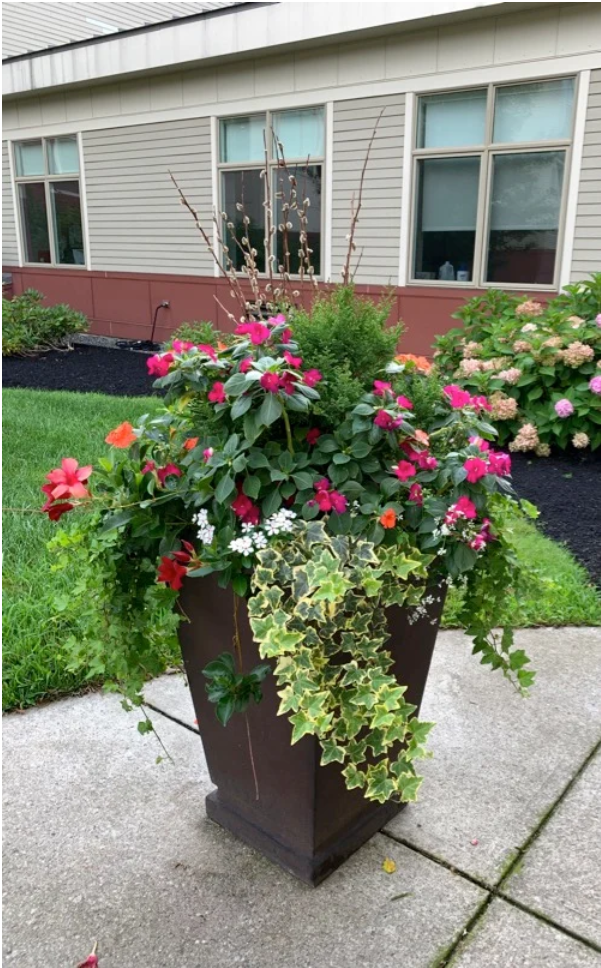
Step Three: Arrange the “Filling” and “Trailing” Elements
- Use “filling” elements to surround the focal point, arranging them in a ring or semi-ring shape to make the composition look full without being too crowded.
- Place “trailing” elements along the edge of the pot, allowing the branches and leaves to naturally curve outwards, breaking the boundaries of the pot, as if the painting is gently overflowing from its frame.
Finally, check the soil level. The final soil level should be slightly lower than the rim of the pot by about 1-2 cm. This allows water to spread on the surface and slowly seep in, rather than overflowing from the edges.
5. Daily Care: Keeping Your Potted Garden Long-Lasting
A container garden is only the beginning of its story from the moment it’s planted. Its true success depends on the care that follows.
- Leave Room for Growth: A slightly “empty” appearance initially isn’t a bad thing. Giving the plant room to spread outwards is beneficial for the overall effect later.
- Watering Rhythm: Containers dry out more easily than ground-planted plants, especially in hot seasons and with highly breathable materials. Check the soil moisture frequently, rather than mechanically watering according to a meter.
- Proper Fertilization: To maintain high flowering levels for annuals within a limited season, you can use a suitable amount of fast-acting fertilizer; while ground-planted plants are better suited to organic, slow-release nutrient sources.
- Timely Maintenance: Removing withered flowers and old leaves encourages the continuous growth of new branches and flowers, allowing the plant to thrive from early spring to late autumn.
- Pay Attention to Pests and Diseases: The earlier pests and diseases are detected, the lower the cost of treatment and the less it affects the overall appearance and neighboring plants.
If time and energy are limited, you can start with one pot and add one or two more each year, allowing the atmosphere in front of your door to accumulate gradually, rather than placing all your expectations on one go.
6. A Flowerpot is a Canvas That Can Be Rewritten at Any Time
The charm of container gardens lies in the fact that there is almost no “irreversible” aspect: if you’re not satisfied, replace the plant; if it doesn’t fit, adjust its position. A potted plant can slowly transform with the seasons, your mood, and your inspiration.
Once you master the structure of “filling, drooping, and scorching,” a single flowerpot can revitalize any space, whether it’s a corner of a balcony, outside a window, or a small empty space next to the doorstep—a unique landscape belonging to this family, this season, and this period of time.